
ByJohn A
Common Measurement and Administration Mistakes Involving Ozempic Click Chart
The most common mistake is treating a pen’s audible clicks as a measuring system. The prescribing information for the semaglutide pen states plainly that a dose should not be set by counting clicks, because only the dose counter and dose pointer show how many milligrams have been selected. Most other reported administration errors trace back to that same substitution.
Why the idea circulates in the first place
Three practical problems drive it. Supply and price push people to stretch a device further than its labeled number of doses. A rough week during titration makes an unlisted in-between amount look appealing. And moving between a branded pen and a compounded vial leaves people holding two very different objects with numbers that do not correspond.
All three are real problems. Counting clicks is a wrong answer to each of them, and it introduces a fourth problem on top: nobody, including the prescriber, then knows what was actually given.
Price and supply also shape where people fill the prescription to begin with. Manufacturer routes such as LillyDirect and NovoCare Pharmacy quote one figure for the branded pen, while telehealth outfits like Ro, Sesame, and HealthRX post their own monthly pricing for Ozempic and for compounded semaglutide. Comparing those published pages before a first refill is a cheaper habit than trying to stretch a device after one arrives.
What the pen is built to deliver
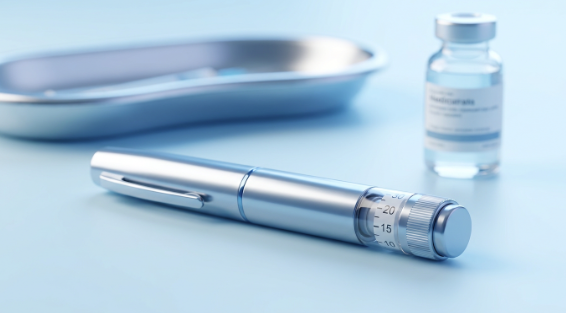
The semaglutide injection pen is a prefilled, single-patient-use, dial-a-dose device. Turning the dose selector moves a mechanical dose counter, and the dose pointer marks the reading. What the device permits is deliberately narrow. According to the DailyMed labeling, the 2 mg/3 mL presentation supports only 0.25 mg or 0.5 mg selections, the 4 mg/3 mL presentation supports only 1 mg, and the 8 mg/3 mL presentation supports only 2 mg. Single-dose prefilled syringes of 0.25 mg, 0.5 mg, and 1 mg exist as separate presentations with no selector at all.
Two design details matter here. When the remaining contents fall below a full dose, the counter stops before that number appears, and the labeling instructs the user to start a new pen rather than inject what is left. And the labeling tells patients never to draw the contents out of the pen with a syringe.
Why the clicks are not a unit
The instructions for use are unusually direct on this point. The pen makes a sound as the selector turns, and the labeling instruction is: Do not set the dose by counting the number of clicks you hear. The same section notes that the selector clicks differently when turned forward than when turned backward, which by itself defeats any counting scheme built on the assumption that every click is equivalent.
There is a deeper reason. Dose accuracy for injection pens is established through testing at the doses the device is designed to select, under defined tolerances. Older work comparing pen injectors with syringes at small volumes found that accuracy and reproducibility differ by delivery method and are worst at the low end. A fraction of a selectable step sits outside anything that was tested, so it carries no accuracy claim at all.
| What people attempt | What happens mechanically | What the labeling says |
|---|---|---|
| Counting clicks to reach an amount not on the pen | The selector stops only at the doses that presentation supports | Do not set a dose by counting clicks; read the dose counter |
| Drawing contents out of the pen with a syringe | Volume delivered is unmeasured and the pen mechanism is bypassed | Never use a syringe to withdraw from the pen |
| Using the last of a pen when the counter stops short | Less than a full dose is delivered | If there is not enough left for a full dose, use a new pen |
| Applying pen figures to a compounded vial | Concentration is set by the pharmacy and differs | Compounded preparations carry no FDA-reviewed label |
| Thinking in insulin units | Units and milligrams are unrelated scales | Semaglutide dosage is expressed in milligrams |
The errors that reach poison centers
This is not theoretical. A case series in the Journal of the American Pharmacists Association described administration errors with compounded semaglutide reported to a poison control center, with dosing confusion at the center of them. A separate characterization of GLP-1 receptor agonist exposures at a single United States poison center found a similar pattern, and a population-based analysis reported rising accidental overdose reports involving this drug class.
The recurring mechanism is not exotic. It is a person converting between two scales that were never meant to be converted, usually a vial and a syringe standing in for a device that used to do the measuring. A retrospective cohort study of an app-based, semaglutide-supported weight-loss service found dispensing errors occur in that supply chain as well, which means the patient is not always the origin of the problem.
The format that arrives decides which mistakes are possible
Whether any of this is even available to get wrong depends on what a program ships. Manufacturer channels such as NovoCare Pharmacy and LillyDirect dispense the branded device with its own instructions for use, so the measuring is done by the pen. Telehealth programs differ: Ro, Hims & Hers, LifeMD, and FormBlends each set their own mix of branded and compounded products at their own cash prices, and a vial plus a syringe is a different risk profile from a dial-a-dose pen at the same monthly cost.
That is a fair question to ask before paying, alongside price. What arrives, in what container, with whose instructions on it.
Compounded preparations do not inherit the numbers
Compounded semaglutide is not FDA-approved. Its concentration is chosen by the compounding pharmacy rather than fixed by an agency-reviewed label, and FDA has published warnings about unapproved versions of these drugs marketed for weight loss. There is no click equivalent for a vial because there is no dose selector, and the milligram figures printed on a branded pen carton do not transfer to it.
Any instruction for a compounded preparation comes from the prescriber who wrote it and the pharmacy that made it. Reconstructing one from a branded label, or from what another patient reported, is how the poison center cases start.
Frequently asked questions
What should someone do after a suspected measuring error?
Contact the prescriber with specifics: which product and container, what the label on it said, what was selected or drawn, when it happened, and any symptoms. The instinct to correct an underdose by injecting again the same day is the part that turns a small error into a reportable one.
Why does the dose counter sometimes stop before the number?
Because the pen no longer holds enough for a full dose. The labeling treats that as a signal to open a new pen rather than to inject the remainder. The counter is reporting available contents, not an alternative dose that happens to be smaller.
Is Ozempic the same as Wegovy?
No. Ozempic is the semaglutide product approved for type 2 diabetes in adults, with additional approved uses in cardiovascular and kidney risk reduction in that population. Wegovy is the semaglutide product approved for chronic weight management. They have different labeled dose steps and different device presentations.
Does the pen need to be checked before the first injection?
The instructions for use include a flow check with each new pen, done once before the first injection from that device, to confirm medication reaches the needle tip. Skipping it is a common omission, and it can hide a blocked needle that stops delivery while the counter still moves.
Are there warnings that apply regardless of technique?
Yes. Semaglutide products carry a boxed warning about thyroid C-cell tumors seen in rodents, and are contraindicated in anyone with a personal or family history of medullary thyroid carcinoma or with multiple endocrine neoplasia syndrome type 2. That screening happens before a first dose, not after a dosing question.
